

A clean plumbing job comes down to a short list of decisions made in the right order. Get the hose construction and matching ends right first, then count fittings and measure length.
1. Choose hose by fluid and pressure
PTFE hose suits fuel, E85, oil and brake lines, and resists fumes. Push-lock hose suits low-pressure fuel, oil and coolant where you want a fast, tool-free build. Braided stainless is a proven general-purpose line, and silicone covers coolant and boost. Pick the construction first, because it decides every fitting after it.
2. Match the hose ends
The end family has to suit the hose. PTFE hose takes PTFE ends, push-lock hose takes push-lock ends, and braided hose takes taper or cutter ends. Both ends of a line come from the same family. Our hose end series guide covers the full breakdown.
3. Pick the AN size
Size the line to the flow it carries. Fuel feed, fuel return, oil feed and oil drain each have a sensible size for the power level, and going too small chokes the system while too big wastes money and space. The AN size chart below gives the starting points.
4. Count your fittings and adapters
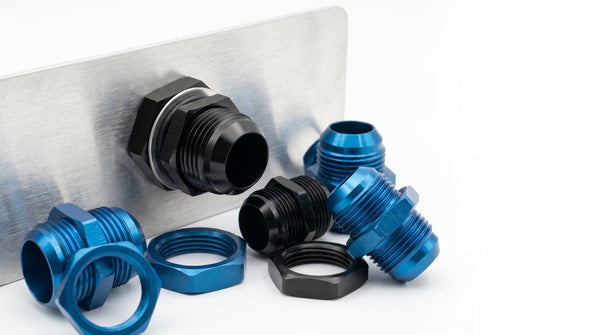
You need one hose end per end of each hose, plus adapters to suit each port, tees for any branch, and bulkhead fittings wherever a line crosses a panel. Ports are often a different thread to AN, so list the adapters too. Write the full list down before you order, so nothing stops the job halfway.
A simple worked example
Say you're running a fuel feed and return on a swap. That is two hose lengths, four hose ends, two adapters at the rail or regulator, two more at the pump or tank, and a bulkhead each where the lines cross the floor or firewall. Listing it out like this is how you avoid a second order.
5. Measure hose length
Route the hose loosely first, add slack for engine movement and bends, then measure. Order a little extra. It's cheaper than coming up short on the last join, and tight bends eat more length than a straight run.
6. Gather the tools
AN spanners protect the anodising on your fittings, a fine-tooth cutoff keeps a clean hose end, and a vice with soft jaws or an assembly tool holds the fitting while you build. PTFE hose has its own assembly steps, covered in the guide below.
Which Aeroflow parts
Browse hose, hose ends, fittings and adapters, and the hose and fabrication tools to do the job.
Related guides
FAQ
How much extra hose should I buy?
Allow a little over your measured length for trimming and a clean first join. Tight radius bends also eat length, so measure with the hose routed, not straight.
Do I need special tools for PTFE?
PTFE assembly has a couple of extra steps over rubber hose. The assembly walkthrough above shows the order so you get a leak-free seal first time.
What AN size do I start with?
Size to the flow the line carries, using the AN size chart as your starting point, then step up if your power target calls for it.