

E85 makes more power, runs cooler, and is gentler on pistons than petrol. It also dissolves half the materials in a stock fuel system.
The conversion isn't bolt-on. It's a parts swap from tank to injector. Here's the full checklist.
What E85 attacks
Three failure modes you need to plan around:
Volume. Ethanol carries less energy than petrol per litre, so injectors need to flow ~30% more to make the same power. Pumps need to push that volume. Lines need to carry it.
Chemistry. Ethanol is a solvent. It dissolves nitrile rubber (factory fuel hose), some plastics (factory fuel filters), and corrodes brass and zinc. It also absorbs water, which then sits in the bottom of your tank and eats steel.
Pressure stability. Higher injector flow rates demand a regulator that doesn't fall over at peak demand. Check what your regulator's internal seals are made of: replace it if they're nitrile, though many modern units are already ethanol-safe. The cheap "performance" aftermarket ones often aren't.
The component-by-component checklist
| Component | Stock problem on E85 | Upgrade to |
|---|---|---|
| Fuel pump | Insufficient flow + brushes wear faster on ethanol | E85-rated 460/525 LPH (e.g. Aeroflow AF49-1057) |
| Pump pickup screen | Polyester mesh OK; some nylon dissolves | Stainless screen + ethanol-safe filter sock |
| Fuel filter | Paper element disintegrates; brass body corrodes | Aeroflow billet alloy + stainless 10-micron element |
| Fuel hose | Nitrile inner liner swells, cracks, sheds into rail | PTFE-lined braided (see PTFE vs rubber) |
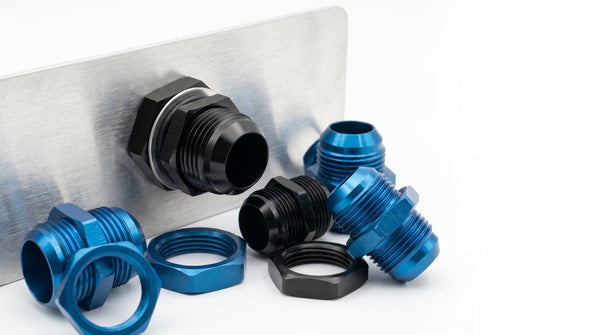
| Hose ends + fittings | Brass corrodes; rubber O-rings swell | Anodised aluminium + Viton O-rings |
| Fuel pressure regulator | Nitrile internal seals swell; many modern units are already ethanol-safe, so check yours | Aeroflow billet regulator with Viton seals |
| Injectors | Static flow too low; some coatings degrade | E85-compatible high-impedance injectors |
| Fuel rail | Stock alloy is usually OK; check for plastic inserts | Billet alloy rail (factory often fine to inspect) |
| Flex-fuel sensor | None fitted | Aeroflow AF49-1555 Continental-style sensor |
| Tune | Stock tune is petrol-only | Flex-fuel map (E0 to E85 interpolation) |
→ Browse the full fuel system range
The flex-fuel sensor question
Two paths:
Static E85 tune. Cheaper. You fuel E85 only. Tune is mapped to E85. It's easier to set up, but you can't run anything else.
Flex-fuel. The sensor reads ethanol percentage by measuring the fuel's dielectric as it flows through the sensor body. The ECU interpolates between an E0 and E85 fuel map. You can mix any blend at the pump, even gas station to gas station, and the engine adapts.
Pump E85 has largely disappeared in NZ. Most builders run drum E85 from race-fuel suppliers, so check availability before you commit. That makes flex-fuel the smart play: no E85 in the shed, top up on 98, your car adapts.
Common conversion mistakes
Reusing the factory fuel filter. "I'll change it later." Three months later your paper element is in the rail. Always do it day one.
Assuming the injector seals are safe. Most modern OEM injector O-rings are already Viton, so check rather than assume; older engines are the risk. If yours are nitrile, pull each injector and swap the lower O-ring to Viton. Five-minute job that prevents a months-later leak.
Forgetting the pickup screen. Factory nylon screens turn to mush on prolonged ethanol exposure. Upgrade to stainless or replace seasonally.
Not draining the tank before first fill. Residual petrol mixed with E85 still works; residual water at the tank base plus ethanol's water-absorption gets you a corrosion start point. Drain the tank, blow it out, fresh start.
Skipping the tune. The same engine running E85 on a petrol map runs lean, hot, and detonates. You will hurt it. Tune first, run second.
What we stock for this
 E85 flex-fuel sensor
Continental-style. 3/8" push-on EFI fittings. Plug-and-play with most aftermarket ECUs.
 Flex sensor bypass block
Black -10 ORB ports. Mounts the sensor inline cleanly to the feed line.
 Flex sensor mounting bracket
6061-T6, black hard-anodised. Keeps the install tidy and protects the sensor from heat.
E85 is the easiest power gain in modern tuning, IF the fuel system can handle it.
Shop E85-Ready Parts → Pumps, regulators, filters, PTFE hose, anodised fittings, flex sensors. All in stock.