

Pulled the intercooler piping after a track day and found pooled oil? That's your PCV.
On boost, your engine pressurises the crankcase faster than the PCV system can vent. The blow-by gets forced up the breather, picks up oil mist on the way, and ends up coating everything between the rocker cover and the intercooler core.
A catch can drops the oil out of the air. Here's how to plumb it properly.
What a catch can actually does
It's a sealed reservoir with two ports. One from the rocker cover, one to the intake. Oily air enters, hits a baffle, slows down, oil droplets condense and fall to the bottom. Dry-ish air continues to the intake.
There's a drain plug at the bottom for periodic emptying. A 1L can on a daily-driven 2.0L turbo needs draining every ~5,000 km. A track-only build might fill it in two events.
The cheap ones are empty pipes with two fittings. They catch almost nothing. A proper Aeroflow can has real internals: the AF64-4363 separator runs stainless mesh media with a billet dipstick, and the AF77-2020 is baffled with a remote drain valve. That's the difference between a catch can and a decorative cylinder.
NA vs boosted plumbing
Naturally aspirated (factory PCV intact):
- One port: rocker cover → catch can → intake manifold (after throttle body)
- Single can is fine. 0.5-1L capacity.
- Vacuum from the intake pulls air through.
Turbocharged / supercharged:
- Off-boost: intake vacuum pulls air through, same as NA.
- On-boost: intake pressure tries to push back. PCV check valve closes. Crankcase pressure rises.
- Need a second port to vent: rocker cover → catch can → intake before the turbo (post-air-filter).
- This is the "dual port" config, and it's still closed-loop because the vent returns to the intake tract. "Atmospheric" means venting to air through a breather filter instead.
A dual breather catch can (the Aeroflow AF77-2020 is the workshop staple) has TWO inlets and TWO outlets. One path for the vacuum side, one for boost-side venting. Cleaner than running two separate cans.
→ See catch cans + breather tanks
Mounting + plumbing rules
Mount BELOW the rocker cover. Drainage is gravity-fed. A can mounted higher than the engine breather just fills the line with oil before it ever reaches the can.
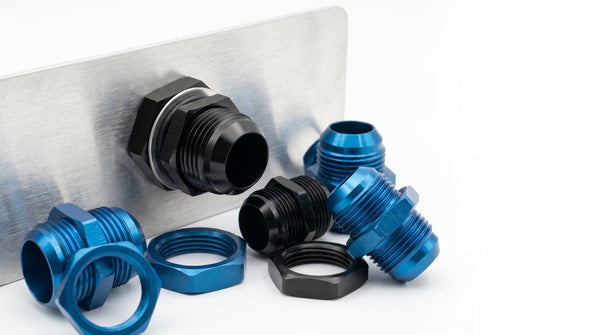
Run -10 AN minimum. Smaller and you'll choke crankcase venting under high RPM, which raises blow-by past the rings and into the sump. Now you're aerating your oil.
Use proper PCV hose. Standard rubber hose softens with oil + heat. Use Aeroflow PTFE-lined or oil-rated braided. Stainless braided looks great until it cracks at the fitting.
Don't bypass the PCV completely on a street car. No PCV = no crankcase vacuum = oil pushed past every gasket and seal you have. Run the can in-line, keep the PCV valve.
Catch can mistakes
Single can on a high-boost build. When the PCV check valve closes under boost, the only relief path is whatever else you've plumbed. Single port = no relief = ring blow-by gets worse, oil consumption climbs.
Skipping the breather filter. If you've gone full atmospheric and vented to atmosphere, you need a filter on the outlet or you'll suck dust and water through your own breather.
Never emptying the can. A full catch can starts pushing oil back into the intake. Most workshops drain every oil change. Easy to forget. The dipstick on the billet separators and the remote drain valve on the breather cans exist for this reason.
Mounting in the wheel arch. Cold air, condensation. Water collects in the bottom of the can, gets sucked back up through the breather. Mount it engine-bay-side.
What we stock for this
 1L dual breather / catch can
Polished. Dual female -10 ORB ports + dual male -10 AN breathers. Dual-path config in one can.
 Billet single air/oil separator
Compact billet body. Single-can street builds. Polished or black.
 Universal catch can extension
Black finish. Fits AF64-4363/4364 cans only, taking capacity from 240ml to 1000ml.
A $250 catch can saves the $2,500 intercooler rebuild. The maths isn't subtle.
Shop Catch Cans → Cans, breather tanks, hose, PCV adapters. Ships overnight from Palmerston North.